

 FP2058 : Role of corneal biomechanics in Idiopathic Intracranial Hypertension (IIH) & its future applications
Dr. Sumitha Muthu
Dr. JYOTI MATALIA, Dr.Abdul Rawoof, Dr. ROHIT SHETTY
Abstract
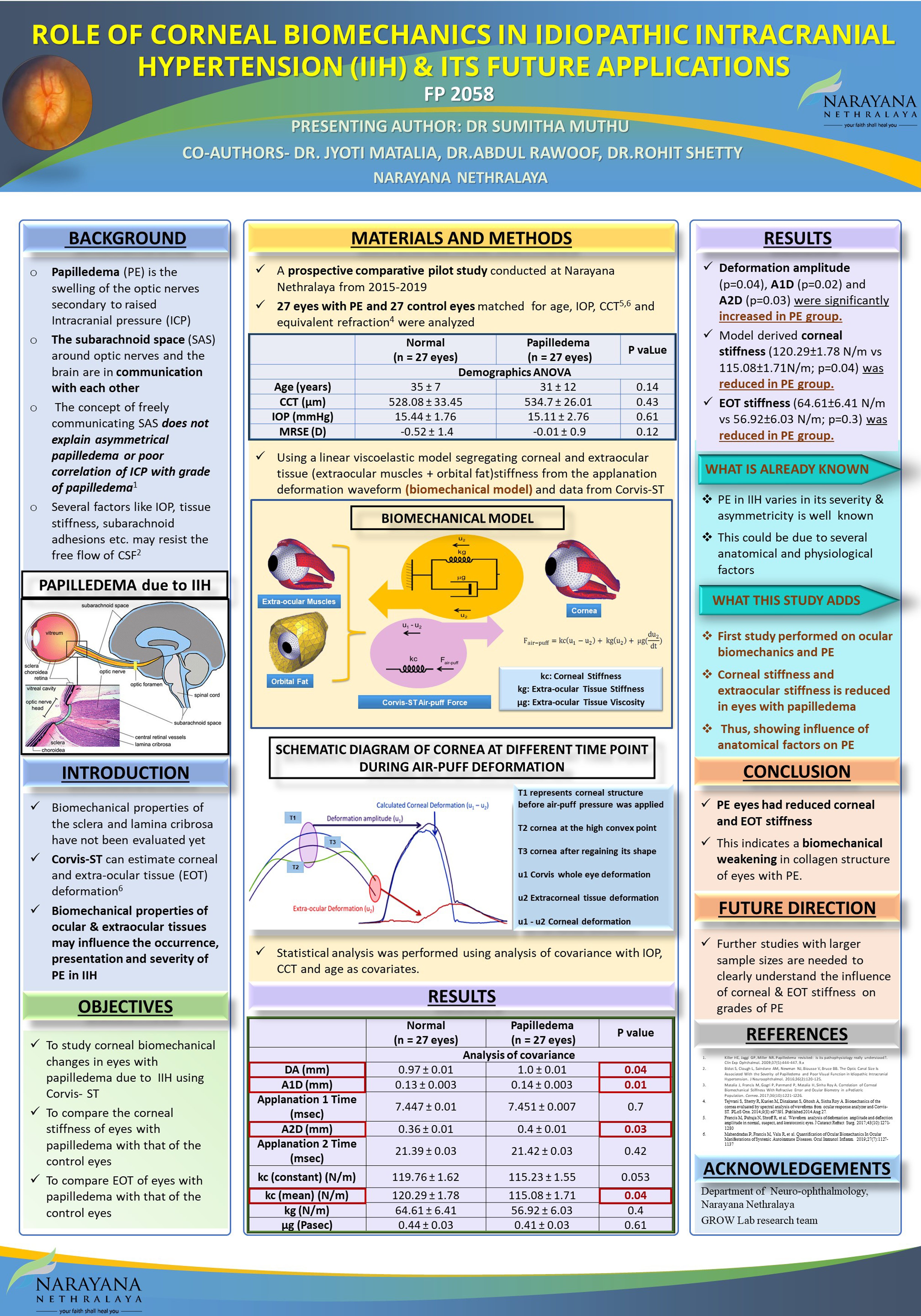
Purpose: To study corneal biomechanical changes in eyes with papilloedema (PE) due to IIH. Methods: 27 eyes with PE and 27 control eyes were analyzed using a linear viscoelastic model segregating corneal and extraocular tissue stiffness from Corvis-ST (Oculus Optikgeräte GmbH, Wet¬zlar, Germany). Statistical analysis was performed using analysis of covariance with IOP, CCT and age as covariates. Results: Deformation amplitude (p=0.04), Applanation 1 deformation (A1D; p=0.02) and A2D (p=0.03) were significantly increased in PE group. Model derived corneal stiffness (120.29±1.78 N/m vs 115.08±1.71N/m; p=0.04) and extra-ocular tissue (EOT) stiffness (64.61±6.41 N/m vs 56.92±6.03 N/m; p=0.3) were reduced in PE group. Conclusion: PE eyes had reduced corneal and EOT stiffness which indicates a biomechanical weakening in the collagen structure of eyes with PE, thus assessing corneal biomechanical parameters may thus be a useful marker in predicting occurence of PE in patients with IIH.
Leave a Comment